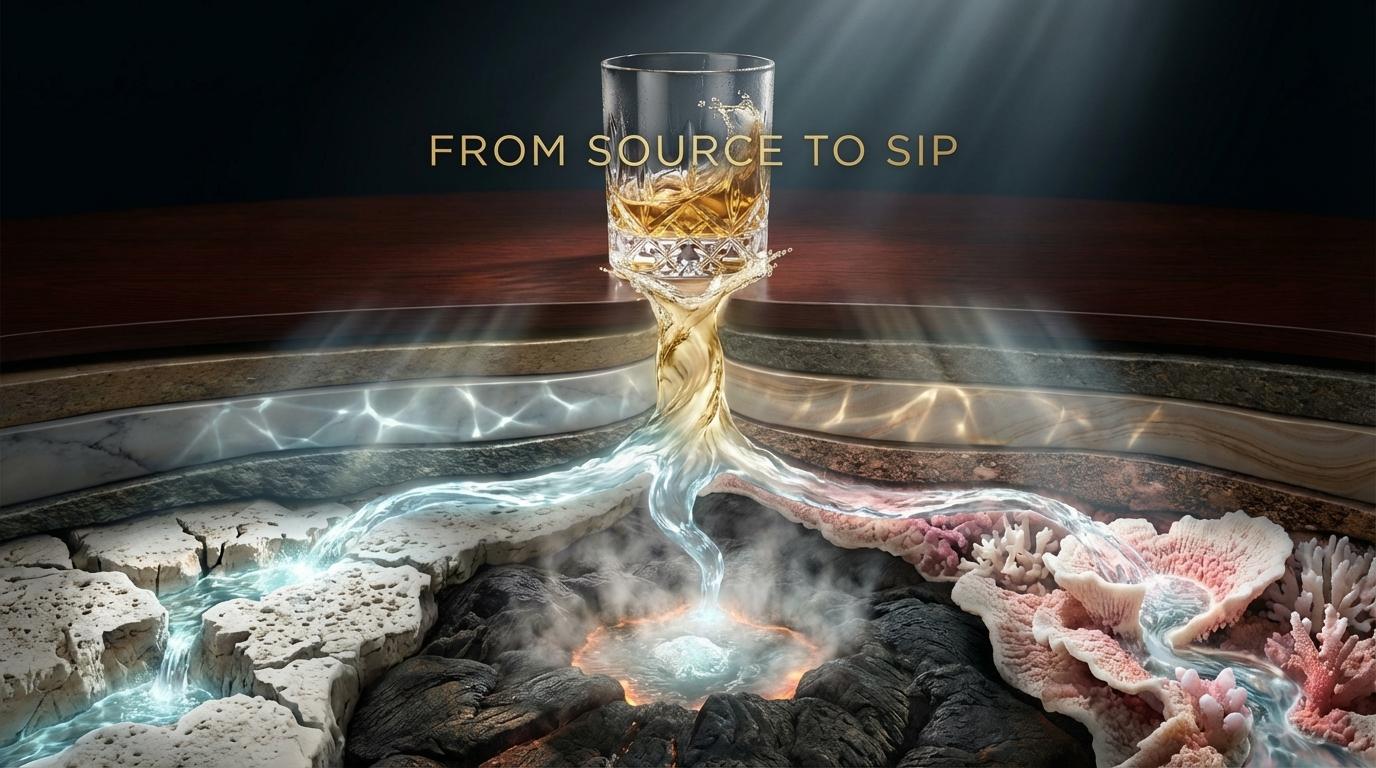

Every bottle in today's lineup begins with water — and not just any water. Buffalo Trace draws from Kentucky's limestone-filtered aquifer, where calcium and magnesium replace iron to create the sweet, mineral-rich foundation that defines great bourbon. Highland Park pulls from Cattie Maggie's Spring on Orkney, where windswept heather and ancient peat color the water before it ever touches barley. Fortaleza's volcanic spring, deep in the slopes of an extinct stratovolcano in Jalisco, carries minerals that shape the character of their agave spirit. And Mount Gay's artesian well, dug in 1703 and filtered through Barbados' coral bedrock, has been making rum for over three centuries.
Water is the invisible ingredient. It shapes fermentation, influences flavor extraction, and carries terroir from the ground into the glass. Today's eight selections are a masterclass in how geography — the springs, rivers, aquifers, and rainfall of eight different places — writes the first chapter of every great drink. Let's pour.
BOURBON Buffalo Trace Kentucky Straight Bourbon

Frankfort, Kentucky — where buffalo once carved paths to salt licks along the Kentucky River, and where distilling has continued uninterrupted since 1775 — even through Prohibition.
Classification: Kentucky Straight Bourbon Whiskey
Company: Sazerac Company
Distillery: Buffalo Trace Distillery, Frankfort, KY (National Historic Landmark)
Proof: 90 (45% ABV)
Age: NAS (approximately 8 years average)
Mash Bill: Undisclosed (estimated ~87.5% Corn, ~9% Rye, ~3.5% Malted Barley)
Color: Burnished gold
MSRP: $25–$34
Nose: Honey, vanilla, toffee, orange zest, caramel, hints of oak
Palate: Brown sugar, vanilla, leather, summer fruit, gentle smoke, tobacco leaf, spice
Finish: Dry and oak-forward with lingering licorice, rye spice, and caramel sweetness
Cocktail — The Limestone Smash: 2 oz Buffalo Trace · 3/4 oz fresh lemon juice · 1/2 oz honey syrup (1:1) · 4 fresh mint leaves. Muddle mint gently, shake with ice, strain into a rocks glass over fresh ice. Garnish with a mint sprig.
Pair with: Smoked brisket with a brown sugar rub — the caramel and smoke in both reinforce each other beautifully.
Awards: Global Distiller of the Year, Whisky Magazine 2022; 100+ awards since 2000
SCOTCH WHISKY Highland Park 12 Year Old

Kirkwall, Orkney — Scotland's most northerly distillery, where the Gulf Stream warms the air, Atlantic gales shape the peat, and heather grows where trees cannot.
Classification: Single Malt Scotch Whisky (Islands)
Company: The Edrington Group
Distillery: Highland Park Distillery, Kirkwall, Orkney, Scotland
Proof: 86 (43% ABV)
Age: 12 Years
Mash Bill: 100% Malted Barley (floor-malted with Orcadian heather peat)
Maturation: European and American sherry-seasoned oak casks
Filtered: Chill filtered
Color: Glowing amber
MSRP: $50–$65
Nose: Heather honey, apricot, orange marmalade, gentle smoke, sea salt, tobacco
Palate: Full and rounded — honey and sea salt, white pepper, cereals, warm oak spice, herbaceous depth
Finish: Starts with sea and smoke, then sweet malt creeps through with lingering warmth
Cocktail — The Orkney Penicillin: 2 oz Highland Park 12 · 3/4 oz fresh lemon juice · 3/4 oz honey-ginger syrup · 1/4 oz Laphroaig 10 float. Shake first three ingredients with ice, strain into a rocks glass over fresh ice, float the Laphroaig on top. Garnish with candied ginger.
Pair with: Smoked salmon with crème fraîche and dill — the gentle smoke and sea salt in both create a seamless pairing.
Awards: Double Gold, San Francisco World Spirits Competition 2023 & 2024
IRISH WHISKEY Redbreast 12 Year Old

Midleton, County Cork — home to Ireland's largest distillery campus, where the soft waters of the Dungourney River feed one of the last great pot still whiskey traditions on earth.
Classification: Single Pot Still Irish Whiskey
Company: Pernod Ricard (Irish Distillers)
Distillery: Midleton Distillery, Midleton, County Cork, Ireland
Proof: 80 (40% ABV)
Age: 12 Years
Mash Bill: 50% Malted Barley, 50% Unmalted Barley (Munster-sourced)
Distillation: Triple Distilled in Copper Pot Stills
Maturation: Ex-bourbon barrels and Oloroso sherry butts
Color: Deep golden amber
MSRP: $60–$65
Nose: Dried orange peel, toasted nutmeg, toasted wood, vanilla, gentle spice
Palate: Silky smooth — cinnamon, clove, toffee, marzipan, fragrant vanilla, dried fruits, walnut
Finish: Lengthy and satisfying with lingering baking spices, custard, and balanced malt sweetness
Cocktail — The Redbreast Sour: 2 oz Redbreast 12 · 3/4 oz fresh lemon juice · 1/2 oz honey syrup · 1 egg white · 2 dashes Angostura bitters. Dry shake, then shake with ice, double strain into a coupe. Garnish with a lemon twist.
Pair with: Warm apple crumble with vanilla custard — the orchard fruit and baking spice in both are a natural match.
Awards: 98 Points, International Wine and Spirit Competition 2019; Multiple Double Gold medals, SFWSC
TEQUILA Fortaleza Reposado

Tequila, Jalisco — on the slopes of an extinct volcano, where fifth-generation tequilero Guillermo Erickson Sauza crushes agave with a two-ton stone the way his ancestors did 150 years ago.
Classification: 100% Agave Reposado Tequila
Company: Destilería La Fortaleza (Guillermo Erickson Sauza)
Distillery: Destilería La Fortaleza (NOM 1493), Tequila, Jalisco, Mexico
Proof: 80 (40% ABV)
Age: 6–9 months in used American whiskey barrels
Production: Tahona-crushed, brick oven–roasted (3 days), open-air wooden tank fermentation, copper pot still distilled
Water Source: Volcanic spring from Volcán de Tequila
Color: Pale straw gold
MSRP: $65–$75
Nose: Roasted pear, vanilla, cinnamon, citrus zest, warm cream, toast
Palate: Cooked agave, citrus, sweet butter, caramel, crème brûlée, green apple, allspice, black pepper
Finish: Moderately tannic with lingering sweet oak, vanilla, and clean agave
Cocktail — The Volcanic Margarita: 2 oz Fortaleza Reposado · 1 oz fresh lime juice · 3/4 oz agave nectar · 1/4 oz Grand Marnier float. Shake with ice, strain into a salt-rimmed rocks glass over ice. Garnish with a lime wheel.
Pair with: Carnitas tacos with fresh pineapple salsa — the roasted pork and sweet fruit echo the caramel and agave in the tequila.
Awards: Double Gold, San Francisco World Spirits Competition
GIN The Botanist Islay Dry Gin

Islay, Scotland — where Bruichladdich's team forages 22 wild botanicals from the island's windswept hills, peat bogs, and Atlantic shoreline, then distills them in a rescued Lomond still they call "Ugly Betty."
Classification: Islay Dry Gin
Company: Rémy Cointreau (Bruichladdich Distillery)
Distillery: Bruichladdich Distillery, Islay, Scotland
Proof: 92 (46% ABV)
Age: Unaged
Botanicals: 31 total — 22 hand-foraged wild Islay botanicals + 9 classic gin botanicals
Distillation: 17-hour slow distillation in Lomond pot still ("Ugly Betty")
Base Spirit: 100% wheat spirit + Islay spring water
Color: Crystal clear
MSRP: $35–$42
Nose: Bright herbal freshness, citrus zest, sweet menthol mint, wildflower bouquet, pine
Palate: Silky and balanced — juniper, lemon, coriander with aniseed undertones, honey from thistle, coconut from gorse
Finish: Lingering herbal notes, coastal salinity, faint anise, and earthy warmth
Cocktail — The Islay Garden: 2 oz The Botanist · 3/4 oz fresh lemon juice · 1/2 oz elderflower liqueur · 3 oz tonic water · Fresh thyme sprig and cucumber ribbon. Build in a large wine glass over ice.
Pair with: Grilled salmon with dill and lemon — the herbal, citrus gin and the herb-crusted fish are made for each other.
Awards: Gold, World Gin Awards 2024; TWE Spirit of the Year 2014
RUM Mount Gay XO

Saint Lucy, Barbados — atop Mount Gilboa, where the world's oldest documented rum distillery has been operating continuously since 1703, fed by an artesian well filtered through ancient coral.
Classification: Extra Old (XO) Rum
Company: Rémy Cointreau
Distillery: Mount Gay Distillery, Saint Lucy Parish, Barbados
Proof: 86 (43% ABV)
Age: Blend of rums aged 5–17 years
Base Ingredients: Barbados molasses
Distillation: Blend of column still and double retort pot still rums
Maturation: Triple cask — American whiskey barrels, ex-bourbon casks, and Cognac casks
Water Source: Artesian well (est. 1703), coral-filtered
Color: Deep golden amber
MSRP: $60–$80
Nose: Roasted coconut, vanilla, charred oak, caramel, clove, Earl Grey tea, marzipan
Palate: Buttery dark chocolate, coconut, vanilla custard, coffee, banana, grilled pineapple, tobacco, leather
Finish: Medium-long with charred oak, ginger spice, stone fruit, and lingering vanilla
Cocktail — The Coral Reef Old Fashioned: 2 oz Mount Gay XO · 1 bar spoon demerara syrup · 2 dashes Angostura bitters · 1 dash chocolate bitters · Express an orange peel over the glass and drop in. Stir over a large cube.
Pair with: Crème brûlée with toasted coconut — the caramelized sugar, vanilla, and coconut mirror the rum's core flavors.
Awards: Double Gold (96 pts), San Francisco World Spirits Competition 2024; Gold, IWSC 2025
RED WINE Château de Beaucastel Châteauneuf-du-Pape 2020

Châteauneuf-du-Pape, Southern Rhône — where the Perrin family has farmed organically since the 1950s, and where ancient glacial river stones called galets roulés absorb the Provençal sun and radiate heat back into the vines at night.
Classification: Châteauneuf-du-Pape AOC
Company: Famille Perrin
Winery: Château de Beaucastel, Châteauneuf-du-Pape, Southern Rhône, France
ABV: 14.5%
Primary Varietals: Grenache and Mourvèdre (co-dominant)
Blend: 30% Grenache, 30% Mourvèdre, 10% Syrah, 10% Counoise, 20% other permitted varieties
Vineyard: 100 hectares; organic since 1950s, biodynamic since 1974; galets roulés terroir
Color: Deep ruby-garnet with excellent concentration
MSRP: $95–$121
Nose: Violet, black-olive tapenade, garrigue herbs, plum cake, leather, toasted almond
Palate: Rich and deep — blue fruit, star anise, sweet spice, blackberry, fine tannins, lovely acidity
Finish: Long and chalky with stony minerality and a silky fade
Cocktail — Beaucastel Sangria Provençale: 1 bottle Beaucastel (or any quality CdP) · 2 oz Cognac · 1 oz crème de cassis · Sliced plums, figs, and orange · Fresh thyme sprigs · 3 oz sparkling water. Combine, chill 4 hours, serve over ice.
Pair with: Slow-braised lamb shoulder with Provençal herbs and olive tapenade — a Southern French wine with a Southern French dish.
Awards: 97 Points, Robert Parker Wine Advocate; 96 Points, Decanter; 95 Points, Wine Spectator
WHITE WINE Cloudy Bay Sauvignon Blanc, Marlborough 2023

Marlborough, New Zealand — where the Wairau Valley's gravelly, free-draining soils and the longest sunshine hours in New Zealand combine to produce the most recognizable Sauvignon Blanc on earth.
Classification: Marlborough GI (Geographical Indication)
Company: LVMH (Moët Hennessy)
Winery: Cloudy Bay Vineyards, Marlborough, New Zealand
ABV: 13.5%
Primary Varietal: Sauvignon Blanc
Blend: 100% Sauvignon Blanc
Winemaking: Primarily stainless steel fermented at low temperature; ~5% in large-format oak; ~1.5% wild yeast fermented
Color: Pale straw yellow
MSRP: $22–$28
Nose: Honeydew melon, passionfruit, vibrant citrus, fresh blackcurrant leaf
Palate: Concentrated and elegant — makrut lime, lemongrass, Meyer lemon, grapefruit skin, stone fruit, hint of sea air
Finish: Long and complex with refreshing saline edge and fresh-squeezed lemon acidity
Cocktail — The Cloudy Bay Spritz: 4 oz Cloudy Bay Sauvignon Blanc · 1 oz Aperol · 2 oz sparkling water · Fresh grapefruit wedge. Build in a large wine glass over ice.
Pair with: Fresh ceviche with lime, cilantro, and avocado — the wine's bright acidity and tropical fruit are a natural partner for raw fish.
Awards: 93 Points, Wine Spectator; 93 Points, Vinous
Train Your Nose: Today's Aroma Spotlight
The Invisible Ingredient — How Water Writes the First Chapter of Flavor
We talk endlessly about barrels, grapes, grains, and botanicals. But every drink in today's lineup started with water — and not all water is created equal. The mineral composition, pH, and source of water profoundly influence fermentation, flavor extraction, and the final character of a spirit or wine.
Consider: Kentucky's limestone shelf naturally filters iron from the water while adding calcium — iron would turn whiskey black and give it a metallic taste, while calcium feeds yeast during fermentation and creates a sweeter, rounder spirit. That's why bourbon country sits on limestone. Highland Park's spring on Orkney delivers soft, low-mineral water through ancient heather peat, contributing the delicate floral smokiness that distinguishes it from mainland Scotch. Fortaleza's volcanic spring carries unique mineral signatures from an extinct stratovolcano. And Cloudy Bay's Wairau Valley vines sit in free-draining gravel beds that force roots deep, where they access mineral-rich subsoil water that expresses itself as the wine's characteristic saline finish.
The lesson? When you taste minerality in a wine, or sweetness in a bourbon, or salinity in a coastal whisky, you're tasting water's invisible hand at work. The ingredient list may start with grain or grape, but the story always begins with the water.
Your training exercise: Open your Bourbon Aroma Masterclass Kit and isolate the Vanilla and Caramel vials. Now pour a dram of any bourbon and let it sit for five minutes. Smell the bourbon, then the vials, then the bourbon again. Notice how the water's mineral character sits underneath those barrel-derived aromas — it's the foundation they rest on. That subtle sweetness that isn't vanilla and isn't caramel? That's the limestone talking.
Today's Kit Reference
| Today's Product | Key Aromas | Train With |
|---|---|---|
| Buffalo Trace | Maple Syrup, Vanilla, Oak, Butterscotch, Caramel | Bourbon Aroma Masterclass Kit |
| Highland Park 12 | Honey, Floral (Rosewater), Smoky, Dried Fruit, Peaty | Whisky Aroma Masterclass Kit |
| Redbreast 12 | Dried Fruit, Vanilla, Clove Spice, Peach, Honey | Whiskey Aroma Masterclass Kit |
| Fortaleza Reposado | Agave (Cooked), Vanilla, Cinnamon, Citrus (Lemon, Lime, Orange, Grapefruit) | Tequila & Mezcal Aroma Masterclass Kit |
| The Botanist | Juniper (Herbaceous/Waxy), Chamomile, Meadowsweet, Lemon, Floral (Rose) | Gin Aroma Masterclass Kit |
| Mount Gay XO | Caramel, Vanilla, Coconut, Coffee, Banana | Rum Aroma Masterclass Kit |
| Beaucastel CdP 2020 | Berry (Generic), Gamey, Cherry, Woody, Violet | Wine Aroma Masterclass Kit |
| Cloudy Bay SB 2023 | Gooseberry, Citrus (Generic), Melon, Green (Cut Grass) | Wine Aroma Masterclass Kit |
Explore the School of Wine and Spirits
Today, water connected all eight of our products — limestone springs shaping Kentucky bourbon, Atlantic-kissed Orkney springs feeding single malt, volcanic aquifers defining artisanal tequila, and coral-filtered wells giving character to the world's oldest rum. Water is the ingredient you can't see on the label, but once you learn to taste its influence, you'll never approach a glass the same way again.
Our books on Amazon go deeper into the science and history behind every sip — from the story of American bourbon in America's Spirit, the whisk(e)y traditions of Scotland's Spirit and Ireland's Spirit, the wines of northern Italy in The Ultimate Northern Italian Wine Journey, the agave revolution in The Tequila y Mezcal Revolution, and the hidden terroir of Burgundy in our Chablis and Côte d'Or pocket guides.
Explore our Aroma Masterclass Kits and books at schoolofwineandspirits.com
Explore our Aroma Masterclass kits and books at schoolofwineandspirits.com
Join the School of Wine and Spirits Community
Connect with fellow connoisseurs, share tasting notes, and go deeper into every pour. Sign up at skool.com/schoolofwineandspirits
Sign up at skool.com/schoolofwineandspirits
Our kits make the perfect gift for the curious drinker in your life — because once you learn to identify aromas, you never taste the same way again.
Know someone who'd love this? Forward this newsletter or share the link — and reply with your own tasting notes. We read every one.
Robert R. Mohr, CPA, CGMA, WSET Level 3, WSG Certified Spirits Specialist — author of America's Spirit, Scotland's Spirit, Ireland's Spirit, The Ultimate Northern Italian Wine Journey, The Tequila y Mezcal Revolution, The Definitive Pocket Guide to Chablis, The Definitive Pocket Guide to the Côte d'Or, and Strategic Tuning. Published author of the Aroma Academy Tequila/Mezcal and Distiller's training kits.
The Still & The Vine is a daily publication of the School of Wine and Spirits.

Share:
Issue 001: The Oak Whisperers — Oak Maturation
Issue 003: Blood on the Label — Family-Owned Producers