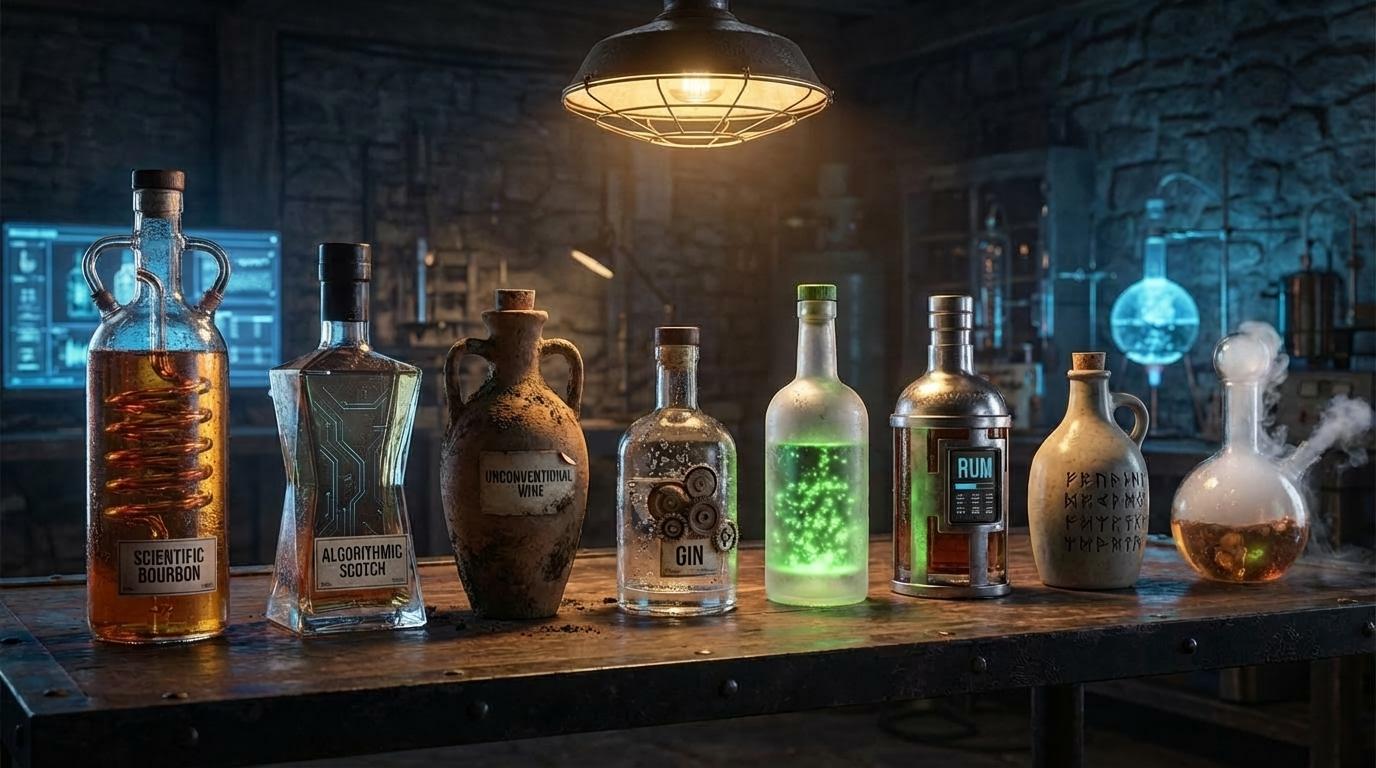

Every bottle begins as a hypothesis. Somewhere, a distiller looked at a convention — a standard grain bill, an accepted maturation protocol, a flavor profile the market had agreed upon — and asked: what happens if we don't? Today's eight selections are united by that question. From Kentucky, a bourbon born in a fermentation laboratory where yeast science replaced guesswork. From the Scottish Lowlands, a single malt whose sweetness and smoke are measured to the parts-per-million, balanced by algorithm as much as instinct. From West Cork, an Irish whiskey finished in casks charred with three-thousand-year-old bog oak pulled from the forest floor.
In Jalisco, a cristalino tequila that ages añejo in whisky and cognac casks, then strips away the color while keeping every layer of complexity. A gin that planted blueberries and blackberries alongside juniper and dared to call the result smooth. A rum where Victorian pineapple rinds meet copper pot stills in an infusion so authentic it redefined what flavored rum could be. A Shiraz harvested from vines half-killed by disease, concentrating fruit into something extraordinary. And in Friuli, an orange wine fermented in buried Georgian amphorae by a winemaker who abandoned every modern tool to prove that the oldest methods still produce the most profound results. These are not safe bets. They are proof of concept.
Today's Selections
BOURBON • SCOTCH WHISKY • IRISH WHISKEY • TEQUILA • GIN • RUM • RED WINE • WHITE WINE
BOURBON Wilderness Trail Small Batch Bottled in Bond

Born in Danville, Kentucky, Wilderness Trail was founded in 2012 by Dr. Pat Heist and Shane Baker — a plant pathologist and a mechanical engineer who had spent years running Ferm Solutions, a fermentation consulting company that sold yeast and lab analysis to distilleries across the industry. When they decided to build their own distillery, they brought a scientist's rigor to every step: their sweet mash process treats bourbon-making as a controlled experiment where every variable is measured and understood. — where Wilderness Trail is what happens when scientists build a distillery instead of inheriting one. The sweet mash process — fermenting with fresh yeast every batch rather than recycling spent mash — produces a remarkably clean, grain-forward bourbon that lets the wheat sing. At bottled-in-bond strength, it carries enough proof to deliver complexity without masking the delicate, biscuity sweetness that makes this wheated expression distinctive. This is bourbon as hypothesis confirmed.
Classification: Kentucky Straight Bourbon Whiskey, Bottled in Bond
Company: Wilderness Trail Distillery
Distillery: Wilderness Trail Distillery, Danville, KY
Proof: 100 (50% ABV)
Age: Minimum 4 Years (Bottled in Bond)
Mash Bill: 64% Corn, 24% Wheat, 12% Malted Barley
Color: Rich amber with warm golden highlights
MSRP: $45–$55
Nose: Warm butterscotch and vanilla leap forward, followed by toasted wheat bread, gentle caramel, and a hint of orchard fruit.
Palate: Creamy and full-bodied with layers of caramel, soft wheat, and baking spice. The sweet mash process delivers a notably clean, bright grain character with none of the sour tang of traditional sour mash.
Finish: Medium-long with lingering butterscotch, toasted oak, and a gentle warmth that fades into sweet corn and vanilla.
Cocktail — The Lab Rat: 2 oz Wilderness Trail BiB, 0.75 oz honey syrup, 0.5 oz fresh lemon juice, 2 dashes Angostura bitters. Shake with ice, strain into a coupe, garnish with a lemon twist.
Pair with: Vanilla bean panna cotta with salted caramel drizzle — the dessert mirrors the bourbon's butterscotch sweetness while the salt lifts the wheat character.
Awards: Gold Medal, San Francisco World Spirits Competition 2023; Double Gold, Denver International Spirits Competition 2022.
SCOTCH WHISKY Ailsa Bay Sweet Smoke

Ailsa Bay sits within the William Grant & Sons complex in Girvan, on Scotland's Ayrshire coast — a Lowland distillery purpose-built in 2007 as a laboratory for experimental whisky-making. Named after the volcanic island of Ailsa Craig visible from its stills, the distillery was conceived by Malt Master Brian Kinsman as a place to test ideas too unconventional for Glenfiddich or The Balvenie. — where Ailsa Bay is a whisky designed by measurement. Malt Master Brian Kinsman assigned each batch a sweetness score (measured in SPPM — sweet parts per million) and a smoke score (measured in phenol PPM), then balanced the two until they achieved equilibrium — a concept he calls Sweet Smoke. The result is unlike heavily peated Islay malts or gentle Speyside drams. It occupies a middle ground that didn't exist before Kinsman built it: controlled peat that enhances rather than dominates, supported by vanilla and honey from the micro-maturation protocol in small Hudson Baby Bourbon barrels. This is Scotch as controlled experiment.
Classification: Single Malt Scotch Whisky
Company: William Grant & Sons
Distillery: Ailsa Bay Distillery, Girvan, Ayrshire
Proof: 97.8 (48.9% ABV)
Age: No Age Statement
Mash Bill: 100% Malted Barley (peated to 22 PPM)
Distillation: Double distilled in copper pot stills
Maturation: Micro-matured in small Hudson Baby Bourbon barrels (25–100 liters), then transferred to virgin, first-fill, and refill American oak casks
Filtered: Non-chill filtered
Color: Pale gold with bright straw highlights
MSRP: $65–$80
Nose: Fresh wood smoke and heather emerge first, followed by oaky vanilla sweetness, candied orange peel, and a whisper of maritime salt.
Palate: Peat and rich vanilla in careful balance — smoke, orchard fruit, and creamy toffee mingle with toasted oak. The sweetness score and phenol count are calibrated to hit precise targets, and you taste that precision.
Finish: Medium-long with oaky sweetness and a dry peat note that lingers without overwhelming, fading into gentle honey.
Cocktail — The Sweet Smoke Old Fashioned: 2 oz Ailsa Bay, 0.25 oz honey syrup, 2 dashes orange bitters. Stir over ice, strain into a rocks glass over a large cube, express an orange peel over the glass and drop it in.
Pair with: Smoked salmon canapés with honey-dill crème fraîche — the smoke meets smoke while the honey bridges to the whisky's sweetness score.
Awards: Gold Medal, International Wine & Spirit Competition 2019; Gold, International Spirits Challenge 2019.
IRISH WHISKEY West Cork Glengarriff Series Bog Oak Charred Cask

West Cork Distillers was founded in 2003 by childhood friends Denis McCarthy, Ger McCarthy, and John O'Connell — two deep-sea trawlermen and a food-industry R&D scientist — in the small town of Skibbereen in West Cork, Ireland. The Glengarriff Series takes its name from the ancient forest nearby, where bog oak — trees preserved for thousands of years in the acidic, waterlogged peat bogs — is harvested and used to char the finishing casks in a process found nowhere else in Irish whiskey. — where The experiment here is elemental: what happens when you char a cask with wood that has been buried in peat for three millennia? The answer is a flavor profile that exists nowhere else in Irish whiskey — a deep, minerally woodiness that isn't quite peat smoke and isn't quite standard oak char. It's something entirely its own. West Cork could have finished this whiskey in standard barrels and sold it for the same price, but they chose to dig into the bogs of Glengarriff and create a finishing process that no one else can replicate. At this price point, it's one of the most original experiments in Irish whiskey.
Classification: Single Malt Irish Whiskey
Company: West Cork Distillers
Distillery: West Cork Distillers, Skibbereen, Co. Cork
Proof: 86 (43% ABV)
Age: No Age Statement (matured in sherry casks, finished 4–6 months in bog oak charred casks)
Mash Bill: 100% Malted Barley
Distillation: Triple distilled in copper pot stills
Maturation: Initial maturation in ex-sherry casks, finished in casks charred with 3,000-year-old bog oak from Glengarriff Forest
Color: Deep amber with reddish copper tones
MSRP: $35–$45
Nose: Spice and dried leather with a sweet dried fruit undertone, layered with cocoa, toasted malt, and a faint whisper of ancient wood smoke.
Palate: Intense spice and cracked pepper give way to toffee, malt, and dark cocoa. The bog oak char contributes a unique woody depth — not peat smoke, but something older and more mineral, like the forest floor itself.
Finish: Medium with toffee, malt, cocoa, and oak fading into a subtle, smoky warmth that speaks of the ancient bog.
Cocktail — The Bog Standard (Anything But): 2 oz West Cork Bog Oak, 0.5 oz Pedro Ximénez sherry, 2 dashes chocolate bitters. Stir over ice, strain into a rocks glass, garnish with a dried fig.
Pair with: Dark chocolate truffles dusted with smoked sea salt — the cocoa and smoke in the whiskey find a mirror in the chocolate, while the sherry cask sweetness bridges to the truffle's cream.
Awards: Silver, International Wine & Spirit Competition; Bronze, San Francisco World Spirits Competition.
TEQUILA Volcán De Mi Tierra Cristalino

Volcán De Mi Tierra was born in 2017 from a collaboration between Moët Hennessy and the Gallardo family, whose Hacienda La Gavilana has sat in the shadow of the dormant Volcán de Tequila since the seventeenth century. The volcano erupted two hundred thousand years ago, enriching the soil with basalt and iron. The Cristalino expression represents an experiment in paradox: aging tequila for years to build complexity, then filtering away the color through charcoal while keeping every layer the barrels gave it. — where The cristalino category is itself an experiment — the proposition that you can age a tequila for years, develop all that barrel complexity, then strip away the amber color through charcoal filtration without losing what the barrels gave you. Volcán De Mi Tierra pushes the experiment further by blending two different aged expressions from two different barrel types before filtering. The result is a tequila that looks like a blanco but drinks like an añejo — an optical illusion in a glass, and a compelling argument that color tells you far less about a spirit than you think.
Classification: Cristalino Tequila (Añejo/Extra Añejo blend, charcoal filtered)
Company: Moët Hennessy (LVMH)
Distillery: Volcán De Mi Tierra, Jalisco, Mexico
Proof: 80 (40% ABV)
Age: Blend of Añejo and Extra Añejo (filtered to clarity)
Agave: 100% Blue Weber Agave
Production: Slow-cooked in traditional brick ovens, double distilled, aged in ex-American whisky and ex-French cognac barrels, then charcoal filtered to remove color
Color: Crystal clear with brilliant silver clarity despite extended aging
MSRP: $55–$70
Nose: Fresh cooked agave and vanilla lead, followed by toasted oak, caramel, and hints of citrus blossom and white chocolate.
Palate: Silky and refined with layers of caramel, vanilla, and dark chocolate. The cognac barrel aging adds dried fruit and a velvety richness, while the charcoal filtration delivers a clarity that makes each flavor note distinct.
Finish: Long and smooth with lingering oak, subtle tobacco, and a clean agave sweetness that fades elegantly.
Cocktail — The Invisible Man: 2 oz Volcán Cristalino, 0.75 oz Cointreau, 0.75 oz fresh lime juice, 0.25 oz agave nectar. Shake with ice, strain into a salt-rimmed coupe, garnish with a lime wheel.
Pair with: White chocolate mousse with toasted coconut — the cristalino's hidden oak complexity emerges against the sweetness, while the agave cuts through the richness.
Awards: Gold, San Francisco World Spirits Competition 2023; 93 Points, Wine Enthusiast.
GIN Brockmans Intensely Smooth Premium Gin

Brockmans emerged in 2008 from a London-based experiment to create a gin that didn't taste like gin — or at least, not like the juniper-dominant London Drys that defined the category. Four entrepreneurs sourced Bulgarian coriander, Tuscan juniper, blueberries, and blackberries, then spent years testing botanical ratios to find a formula where dark fruit could coexist with traditional gin botanicals without tipping into flavored-spirit territory. — where Brockmans asked a question the gin world wasn't asking: what happens when you build a botanical bill around dark berries instead of amplifying juniper? The answer divided purists — some argued it wasn't really gin — but the market voted with its wallet. The blueberries and blackberries create a textural smoothness and a berry-forward aromatic profile that no other gin had attempted at this scale. Critically, it still works as gin: the juniper is there, the botanical complexity is there, the spirit is dry. Brockmans proved you could expand the definition without breaking it.
Classification: Premium Gin (New Western Style)
Company: Brockmans Gin Ltd.
Distillery: G&J Distillery, Warrington, England
Proof: 80 (40% ABV)
Botanicals: Tuscan juniper, Bulgarian coriander, blueberries, blackberries, Valencian orange peel, lemon peel, cassia bark, angelica root, orris root, almonds, licorice
Distillation: Botanicals steeped for 14 hours, then distilled over 9 hours in century-old copper pot stills
Base: Neutral grain spirit
Color: Crystal clear
MSRP: $30–$40
Nose: Dark berries emerge immediately — blueberry and blackberry — underpinned by soft juniper, coriander, and a gentle citrus brightness from Valencian orange peel.
Palate: Remarkably smooth and round, with the berry botanicals creating a velvety texture. Juniper stays present but restrained, letting cassia bark spice and a subtle floral violet note play supporting roles.
Finish: Medium with lingering dark fruit, a hint of warm spice from the cassia bark, and clean citrus that keeps the finish refreshing rather than heavy.
Cocktail — The Berry Hypothesis: 2 oz Brockmans, 0.75 oz fresh lemon juice, 0.5 oz simple syrup, 3 fresh blackberries. Muddle berries, add remaining ingredients, shake with ice, double-strain into a coupe, garnish with a skewered blueberry and blackberry.
Pair with: Brie and blackberry crostini drizzled with honey — the gin's berry botanicals echo the fruit while the juniper cuts through the richness of the cheese.
Awards: Gold, International Spirits Challenge; Gold, San Francisco World Spirits Competition 2022.
RUM Plantation Stiggins' Fancy Pineapple

Plantation's Stiggins' Fancy was born from a historical obsession. Maison Ferrand's Alexandre Gabriel and cocktail historian David Wondrich discovered nineteenth-century recipes for pineapple rum — buried in the 1824 English Journal of Patent and Inventions and the 1844 Journal of Agricultural Society — and set out to recreate the Victorian-era practice using modern distillation and real Queen Victoria pineapples. The name honors Reverend Stiggins from Dickens' The Pickwick Papers, a character famously fond of pineapple rum. — where Before Stiggins' Fancy, flavored rum meant artificial sweeteners and neon colors. Alexandre Gabriel and David Wondrich's experiment asked a different question: what if you used real fruit, real distillation, and treated infusion as seriously as barrel aging? The dual-infusion method — rinds distilled for bright aromatics, fruit macerated in dark rum for depth — is an engineering solution to a flavor problem. The result is a rum that tastes genuinely of pineapple without tasting like a pineapple candy. It proved that the flavored spirits category could be legitimate, and it changed the conversation for every brand that followed.
Classification: Pineapple-Infused Rum (Not a Liqueur)
Company: Maison Ferrand
Distillery: Maison Ferrand, Ars, France (blending and infusion) using Caribbean base rums
Proof: 80 (40% ABV)
Age: Blend aged 3 months in oak after infusion
Base: Dual infusion: pineapple rinds in Plantation 3 Stars white rum (pot-distilled), fruit flesh in Plantation Original Dark rum
Distillation: Rind infusion redistilled in Ferrand copper pot stills; fruit infusion left intact; both blended and rested in oak
Color: Dark amber-brown with mahogany highlights
MSRP: $28–$35
Nose: Fresh pineapple leaps from the glass — ripe, tropical, and unmistakable — followed by banana, demerara sugar, clove, cinnamon, and black pepper spice.
Palate: Rich and layered with authentic pineapple flavor supported by dark brown sugar, toffee, and warm baking spices. The dual-infusion technique gives both bright tropical fruit from the rind distillation and deep, jammy sweetness from the dark rum fruit maceration.
Finish: Long and slightly dry with lingering spice, a touch of acidity, and pineapple that persists as a top note over a base of brown sugar and oak.
Cocktail — The Dickens Daiquiri: 2 oz Plantation Pineapple, 0.75 oz fresh lime juice, 0.5 oz rich demerara syrup, 2 dashes Angostura bitters. Shake with ice, double-strain into a chilled coupe, garnish with a dehydrated pineapple ring.
Pair with: Grilled pineapple with coconut cream and toasted macadamia nuts — the caramelized fruit amplifies the rum's pineapple, while the coconut and nut add tropical richness.
Awards: 95 Points, Wine Enthusiast; Double Gold, San Francisco World Spirits Competition; Rum of the Year, Caribbean Journal.
RED WINE d'Arenberg The Dead Arm Shiraz 2019

d'Arenberg has farmed McLaren Vale since 1912, but The Dead Arm takes its name from something no farmer wants: Eutypa lata, a fungal disease that kills one arm of the vine while the surviving arm produces dramatically reduced yields of intensely concentrated fruit. Fourth-generation winemaker Chester Osborn turned this affliction into an experiment — harvesting only the surviving arm's tiny, flavor-packed berries to create one of Australia's most celebrated single-varietal Shiraz wines. — where The Dead Arm is an experiment in turning disaster into distinction. Most growers would rip out vines afflicted with Eutypa lata, but Chester Osborn saw what the disease did to the surviving fruit — concentrated it, intensified it, made it something a healthy vine could never produce. The resulting wine is enormously concentrated without being heavy, packed with dark fruit and cedar but retaining the savory, earthy character that marks great McLaren Vale Shiraz. It's a reminder that some of the best things in wine happen when nature forces the maker's hand.
Classification: McLaren Vale Shiraz
Company: d'Arenberg Pty Ltd
Winery: d'Arenberg, McLaren Vale, South Australia
ABV: 14.5%
Primary Varietal: 100% Shiraz
Blend: 100% Shiraz from vines affected by Eutypa lata (Dead Arm)
Vineyards: Estate vineyards in McLaren Vale, South Australia — old vines affected by Eutypa lata
Maturation: 20 months in French oak barriques (approximately 40% new)
Color: Deep, opaque purple-black with violet rim
MSRP: $50–$65
Nose: Intense black cherry and dark plum lead, layered with mocha, Kalamata olive, dark chocolate, and a lift of violet and dried herb.
Palate: Full-bodied and deeply concentrated with plush blackcurrant, cherry, and cedar. The tannins are plentiful but ripe, and the French oak adds structure without masking the fruit's intensity.
Finish: Long and persistent with cedary oak, cherry, and a savory, earthy note that lingers.
Cocktail — The Survivor Sangria: 4 oz Dead Arm Shiraz, 1 oz brandy, 0.5 oz orange liqueur, fresh orange and cherry slices, splash of sparkling water. Combine in a glass with ice, stir gently.
Pair with: Slow-braised lamb shoulder with rosemary and Kalamata olives — the wine's dark fruit and savory olive notes find a perfect mirror in the dish.
Awards: 96 Points, James Halliday; 94 Points, Wine Spectator; Langton's Classification of Distinguished Australian Wine.
WHITE WINE Gravner Ribolla Gialla 2015

Josko Gravner was once one of Italy's most acclaimed modernist winemakers — stainless steel, temperature control, the full technological arsenal. Then, after a crisis of faith in the mid-1990s when he realized he no longer enjoyed drinking his own wines, he traveled to Georgia in 2000. By 2001, he had buried eleven handcrafted Georgian amphorae beneath his cellar in Oslavia, Friuli, and began fermenting Ribolla Gialla on its skins using only wild yeasts, no temperature control, no fining, and no filtration. The result helped launch the modern orange wine movement. — where Gravner's experiment was the most radical in this lineup: he didn't tweak a process or add an ingredient — he threw away thirty years of modern winemaking and started over with seven-thousand-year-old technology. The Ribolla Gialla spends months on its skins in buried amphorae, developing a tannic structure and amber color that no conventional white wine possesses. Then it rests for six years in large oak before release. The result is a wine that defies categorization — not white, not red, not rosé, but something ancient and entirely its own. It proved that the oldest methods in winemaking weren't primitive — they were ahead of their time.
Classification: Orange Wine (Skin-Contact White), Venezia Giulia IGT
Company: Gravner
Winery: Gravner, Oslavia, Friuli-Venezia Giulia, Italy
ABV: 14.0%
Primary Varietal: 100% Ribolla Gialla
Blend: 100% Ribolla Gialla, extended skin contact
Vinification: Fermented in buried Georgian amphorae with extended skin maceration, wild yeast only. 5 months in amphorae, then 6 years in large Slavonian oak casks. No fining, no filtration.
Color: Deep amber-gold with copper highlights
MSRP: $70–$95
Nose: Complex and layered with dried apricot, orange peel, honey, resin, and a subtle note of white truffle. The extended aging brings nuances of caramel and nutmeg.
Palate: Dense and richly textured with flavors of citrus peel, roasted nuts, and honey. The skin contact gives the wine a tannic grip unusual for a white — more like a light red in structure — while the acidity remains bright and precise.
Finish: Exceptionally long with mineral, citrus zest, and a sapid, almond-like persistence that seems to evolve in the glass.
Cocktail — The Amphora Spritz: 3 oz Gravner Ribolla Gialla, 1 oz Aperol, 2 oz sparkling water. Build over ice in a wine glass, stir gently, garnish with a dried apricot slice.
Pair with: Aged Parmigiano-Reggiano with honeycomb and walnuts — the wine's tannic structure and nutty complexity meet the cheese as equals, while the honey bridges to the Ribolla's amber sweetness.
Awards: Tre Bicchieri, Gambero Rosso (multiple vintages); recognized as a foundational wine of the orange wine movement by Jancis Robinson MW.
Train Your Nose: Today's Aroma Spotlight
The Experimenter's Palette
Experimentation doesn't just happen in the distillery or vineyard — it belongs at your tasting table. Today's training exercises challenge you to isolate the unexpected aromas that emerge when makers push boundaries. Use your School of Wine and Spirits Aroma Masterclass Kit to identify each note, then compare the experimental expression against a conventional benchmark. The contrast is where learning lives.
Begin with the Wilderness Trail bourbon and focus on Wheat — the soft, biscuity grain note that replaces the spice of rye in the mash bill. Pour a standard high-rye bourbon alongside it and nose them back to back. The wheat delivers a pillowy, almost pastry-like sweetness where rye would put pepper and bite. Now move to the Ailsa Bay and seek the interplay between Smoky and Vanilla — two notes that typically compete but here exist in measured equilibrium. Compare it against a heavily peated Islay malt to feel how the Sweet Smoke concept constrains the peat rather than unleashing it.
Next, contrast the Plantation Pineapple rum's Tropical Fruits note against a standard aged rum — the difference between infusion and barrel-derived fruitiness is stark and instructive. With the Gravner Ribolla Gialla, seek the Honey and Citrus (Generic) notes that skin contact creates in a white grape — pour a conventional unoaked Friulian white alongside it and notice how the amphorae fermentation builds texture and warmth that stainless steel never delivers. Finally, return to the d'Arenberg Dead Arm and locate the Cherry and Violet — the concentrated signature of fruit from stressed, low-yield vines.
Today's Kit Reference
| Today's Product | Key Aromas | Train With |
|---|---|---|
| Wilderness Trail Small Batch Bottled in Bond | Vanilla, Caramel, Wheat, Corn, Butterscotch, Oak | Bourbon Aroma Masterclass Kit |
| Ailsa Bay Sweet Smoke | Smoky, Peaty, Vanilla, Caramel, Honey, Orange | Whisky Aroma Masterclass Kit |
| West Cork Glengarriff Series Bog Oak Charred Cask | Cocoa (Dark), Dried Fruit, Malt, Smoky, Vanilla, Woody | Whiskey Aroma Masterclass Kit |
| Volcán De Mi Tierra Cristalino | Vanilla, Caramel, Agave (Cooked), Oak, Chocolate (Dark Chocolate, Cocoa), Citrus (Lemon, Lime, Orange, Grapefruit) | Tequila & Mezcal Aroma Masterclass Kit |
| Brockmans Intensely Smooth Premium Gin | Juniper (Green), Coriander, Cassia Bark, Orange, Vanilla, Violet | Gin Aroma Masterclass Kit |
| Plantation Stiggins' Fancy Pineapple | Tropical Fruits, Banana, Vanilla, Spice (Generic), Caramel, Oak | Rum Aroma Masterclass Kit |
| d'Arenberg The Dead Arm Shiraz 2019 | Cherry, Blackcurrant, Violet, Cedar, Toasted, Woody | Wine Aroma Masterclass Kit |
| Gravner Ribolla Gialla 2015 | Honey, Citrus (Generic), Nut (Almond/Coconut), Toasted, Woody, Floral (Rose) | Wine Aroma Masterclass Kit |
Explore the School of Wine and Spirits
Today's eight selections prove that the best producers are architects first. Our books on Amazon take you deeper into those places — from the limestone hollows of Kentucky in America's Spirit, the misty distilleries of Scotland's Spirit and Ireland's Spirit, the volcanic highlands of The Tequila y Mezcal Revolution, the ancient vineyards of The Ultimate Northern Italian Wine Journey, and the fossilized seabeds of Burgundy in our Chablis and Côte d'Or pocket guides.
Explore our Aroma Masterclass kits and books at schoolofwineandspirits.com
Join the School of Wine and Spirits Community
Connect with fellow connoisseurs, share tasting notes, and go deeper into every pour. Sign up at skool.com/schoolofwineandspirits
Our kits make the perfect gift for the curious drinker in your life — because once you learn to identify aromas, you never taste the same way again.
Know someone who would enjoy The Still & The Vine? Forward this issue to a fellow enthusiast — or share it on social media and tag @SchoolofWineandSpirits. We grow by word of mouth.
Until tomorrow's pour — cheers.
Robert R. Mohr, CPA, CGMA, WSET Level 3, WSG Certified Spirits Specialist — author of America's Spirit, Scotland's Spirit, Ireland's Spirit, The Ultimate Northern Italian Wine Journey, The Tequila y Mezcal Revolution, The Definitive Pocket Guide to Chablis, The Definitive Pocket Guide to the Côte d'Or, and Strategic Tuning. Published author of the Aroma Academy Tequila/Mezcal and Distiller's training kits.
The Still & The Vine is a daily publication of the School of Wine and Spirits.

Share:
Issue 025: The Slow Reveal - Layer by Layer
Issue 027: The Proving Ground - Experiential Proof